The Later Rome, A lot Like Us…

“Dad, don’t take this personally, but I sort of prefer the early Romans to the later Romans…”

So announced my 10 year old yesterday afternoon. Granted, it’s an odd conversation anyway you slice it – the fellow is 10 years old after all. But leaving that aside, one understands his attraction to the polish and power of Octavian’s Rome, or Scipio’s Rome. Theirs was a Rome of potential, a Rome of power still-in-store, a world-beating Rome.
And yet I still gravitate to the later Rome, the Rome that snooty Victorians (and Hollywood along with the popular press) called “Byzantine”. For two hundred years we have denigrated them rather than giving these Romans – that survived everything that human-kind and nature could throw at them – their due. For 1,000 years after their cousins in the West gave up the ghost they survived (from 476 to 1453), managing a more mellow “greatness” than Old Rome despite overwhelming odds. Knowing that the proverbial writing was on the wall they soldiered on in philosophy, art, law, diplomacy, architecture, etc. for our benefit. In short, even though the darkness fell around them, the Eastern Roman Empire kept the flame of culture and civilization alive longer than anyone, even their own contemporaries, expected. In fact, they kept this flame burning just long enough for the semi-barbarous nation states of the West to “rediscover” it, to appropriate it as their own and to call it the “Renaissance”.
In the last few weeks two exciting archaeological discoveries caught my eye and reminded me (and the 10 year old) how great was the span of my preferred Rome – the Justinian-era Rome of the 6th century – centered in Constantinople. Enjoy this touch of their cool and immortal Empire as so much in our 2017 world seems to reek of shrill and decline.
ROME IN CHINA
The first of these discoveries surfaced last month in China, when archaeologists opened a mid-6th century tomb of a wealthy Chinese man and found what the archaeologists described as coins minted during the reign (and sporting the likeness) of Justinian the Great who ruled Rome from 527CE to 565CE. As described in the China Daily News:
“The tomb’s owner, Lu Chou, died in 548 and the burial artifacts excavated include intact colored pottery figurines, camel figures and, most importantly, two gold coins from the Eastern Roman Empire… The gold coins are thought to be the earliest foreign currency coins to have been found in China.”
Surprised? It makes one wonder why Marco Polo receives such adulation still for “opening up” China in 1271CE when the Romans had regular trade with China stretching back to the days of the Roman Republic. This Roman-Chinese relationship remained active up until (and beyond) Justinian’s reign as the recovery of these coins illustrates. Rome was extremely desirous of Chinese silk, one of the most mysterious and prized substances in the Empire for many centuries, used to clothe Emperors and the Senatorial class. In fact, it was during Justinian’s rule, and at his behest, that Roman spies (dressed as priests) smuggled silkworm nests out of China in hollow canes so that the Romans might begin to manufacture their own silk, thereby cutting out Persian and Arab middlemen.
This daring does not sound like the work of a “lesser” Rome to me.
Please see pictures of the coins, and the tomb in which they were found, in the first two images below.


ROME IN ISRAEL
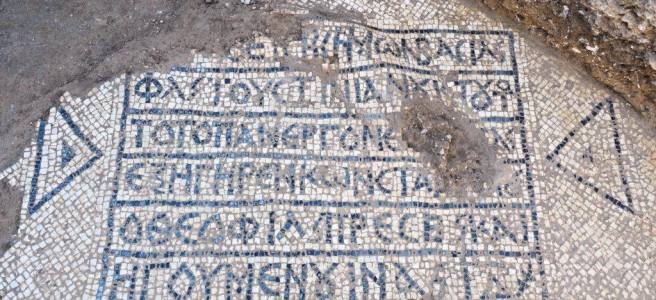
Across the globe this week archaeologists announced the most exciting Justinian-era discovery in some years, a perfectly intact Greek inscription commemorating the construction of a hostel for Roman pilgrims traveling to Jerusalem (which at that time was known to Romans as Aelia Capitolina, as named some centuries before by the Roman Emperor Hadrian who rebuilt the city that had been destroyed by the Romans during the Siege of Jerusalem in 70CE).
Nothing similar had been found in Jerusalem since the 1970’s when archaeologists stumbled upon the Nea Church, built by the Emperor Justinian as a replica of Solomon’s original temple and believed to possibly housed the Treasure from Herod’s second temple, a treasure that had been recovered by Justinian’s great general Belisarius after he nearly single-handledly defeated the Vandals and recovered Roman Africa for the Empire (highlighted in my novel, “Avenging Africanus”).
So, Titus destroyed Jersusalem and committed countless atrocities on its Jewish residents in the process, Hadrian rebuilt (a pagan) Jerusalem, Constantine made her a Christian city and Justinian made her a major Roman city, the most important city of Roman Palaestina.
The triumphant, miraculous Greek inscription recovered this week had been buried just below the surface of Jerusalem’s Old City for 1,500 years and escaped certain destruction by a matter of mere hours, since the area where it was located was to be leveled and excavated the following day in order to lay communications cables outside the American Consulate in Jerusalem. Justinian’s words come directly to us thanks to sheer chance, discovered on the very last day of the dig! Had one more day passed this message from the latter-day Romans would have been pulverized so that the latter-day Americans might send their messages more efficiently.


The Greek inscription was deciphered by the Hebrew University’s Dr. Leah Di Segni, an expert on ancient Greek inscriptions and reads as follows:
“In the time of our most pious emperor Flavius Justinian, also this entire building Constantine the most God-loving priest and abbot, established and raised, in the 14th indiction.”
The archaeologist who discovered it believes that it was written to commemorate the founding of the building — presumed to be a pilgrim hostel — by a priest named Constantine, the ‘hegumen’ of Jerusalem. The word “indiction,” said Di Segni, “is an ancient method of counting years, for taxation purposes. Based on historical sources, the mosaic can be dated to the year 550/551 CE.”
So, in short, our ‘later’ Romans, our much maligned Byzantines, traded with China, sheltered pilgrims in Jerusalem, and created works of enduring beauty and influence as the wider world crumbled about them. These are not the achievements that will necessarily hold a child’s attention, nor will it attract Hollywood’s celebrity, but for my druthers it does not get much better than this.
And finally, at the end of a long hot summer where there has been much (too much) talk of the USA’s decline and fall, I for one take heart from Rome’s endurance. She waxed and waned but she survived, inspired, and remained relevant even after “early” turned to “late”, lighting the way forward for those who came after.
Restoration of Justinian’s Basilica Cistern

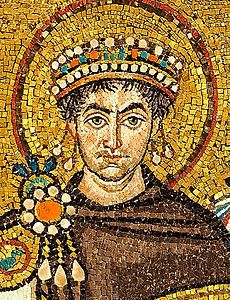
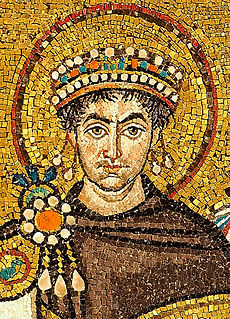
Exciting news emerged this week from the world of Archaeology pertaining Mosaic_of_Iustinianus_I_-_Basilica_San_Vitale_(Ravenna)to the Emperor Justinian the Great and one of the greatest Roman feats of engineering and architecture still standing (albeit underground).
 
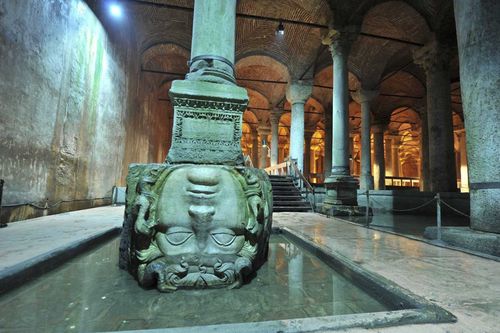
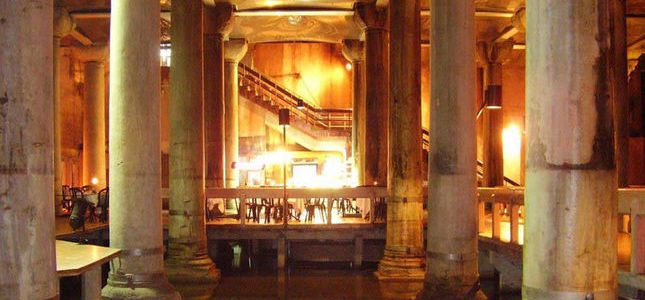
Anyone who has ever visited Istanbul has surely visited the Basilica Cistern, known in Turkish as the “Yerebatan Sarnıcı”. Located across the street and 645x400-basilica-cistern-set-for-comprehensive-restoration-1483481203740 underground from the Hagia Sophia in the heart of what once was Constantinople – capital of the Roman Empire for one thousand years and before that it was the Greek colony of Byzantium – the Cistern is an architectural marvel completed by the Emperor Justinian the Great (though it was likely begun during the reign of his uncle, the Emperor Justin).
 
The cistern was built to hold water that might keep the city’s thirst quenched in the event of siege or drought – though it was one of many that littered the city it was far and away the most important. But to call it a reservoir is to do it a grave injustice. It is a work of grace and beauty, built underneath the city streets in the heart of Constantinople. To enter it is to enter a magical space, in some ways (to me at least) it feels as ethereal and transcendent as the grand basilica above. The roof that towers above is supported by 336 columns rising 30 plus feet into the air, reflected in the water that still partially fills the room. A number of those columns contain recycled elements, including 0x0-basilica-cistern-set-for-comprehensive-restoration-1483481201380masonry that the Romans recovered from the more ancient Greek city of Byzantium like the absolutely breathtaking Medusa heads that form the base of two columns (see picture to the right).
 
To walk into the Cistern is to step 2,000 years back in time to the last era of the Romans when they still possessed the technological expertise, capital, and desire to build truly monumental works. Imagine that this place (pictures below) was never built to be seen, to entertain visitors, to awe tourists – it was simply built to hold water! Could we build something so regal today even if we tried? Its hard to contemplate. One cannot look at such a thing and wonder about, and to be awed by, the civilization that was capable of creating it.
 
So, the news this week is that Turkey will embark upon an ambitious restoration of the Cistern (along with the Milion that rests above it – the mile-marker from which all distances in the Empire were measured since Old Rome was lost to the Goths). One cannot help but wish them well and hope that the restoration is done with tact.
 
For more on the restoration see here
 

A special request, from the Author

A request from the Author to those of you (special souls and odd ducks all of you) who have read one of my books.MJS Museum

The most important way that indie authors like me can ‘promote’ our books is through the reviews that readers post online, especially on Amazon.com and at book-club sites like Goodreads.

On Amazon, the undeniable Goliath of the book world, the placement of my books is entirely determined by the number and quality of my reviews (good or bad, to an author an honest negative review is more important than a false glowing review!).

To the readers of my books, I ask you to please, pretty please, take two seconds and leave an online review as short or long as you would like online at Amazon – it makes an IMMENSE difference to the humble author plugging away without publicist, editor, ad agency, etc.

To post a review at Amazon please see me here:

amazon.com/author/matthewjstorm

And to post on Goodreads, please see me here:

https://www.goodreads.com/…/s…/6209063.Matthew_Jordan_Storm…

MANY THANKS TO YOU ALL!

Matthew Jordan Storm

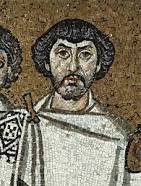
General Belisarius Enters Rome – on this day in 536CE

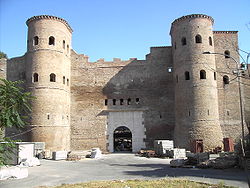
On this day, December 9th in 536CE, Roman General Flavius Belisarius (pictured above) entered the city of Rome through the Asinarian Gate (seen below) with his small cohort of Roman knights.

250px-Porta_Asinaria_2948

The city’s residents had not seen a Roman Legionnaire for almost exactly 60 years, when what remained of the Western armies deserted the Eternal City when the Goth warlord Odoacer toppled the last Western Roman Emperor, Romulus Augustulus.

Since that time, Rome (the city) had been under the control of a series of Goth rulers, including Odoacer, Theodoric (the “Great”), Amalasuntha (daughter of Theodoric), Theodad (cousin of Amalasuntha and her murderer) and at the time of Belisarius’ arrival, the Goth King Vitiges.

Imagine that!  For 60 years, the Roman Empire had gone about its business with an Emperor mounted on a throne in Constantinople, while Rome herself – the birthplace of Empire – was held by barbarians.  Imagine a United States continuing to exist, and to thrive, with a Washington D.C. belonging to a foreign power.  It sounds inconceivable and so it was to the Emperor Justinian who was determined to accomplish what none had dared, to return Rome to Rome.

By the time that Belisarius arrived in Rome his exploits (in Persia and Africa) were the stuff of legend.  But he arrived woefully understaffed and soon faced a Goth army that exceeded 100,000 in number surrounding the city, determined to crush Belisarius and with it, Justinian’s aspirations of restoration.

Absolutely fascinating stuff!

Following is a Wikipedia link which does a decent job of summarizing the ensuing Siege of Rome.

Justinian’s “Flat-Pack” Church, Raised from the Seabed

“We hope it will be easier [to assemble] than an Ikea wardrobe.”
– Dr Alexander Sturgis, Oxford University

A prefabricated church, built in Justinian’s Constantinople and lost at sea off the coast of Sicily 1,500 years ago will soon be reassembled in Oxford University’s Ashmolean Museum.

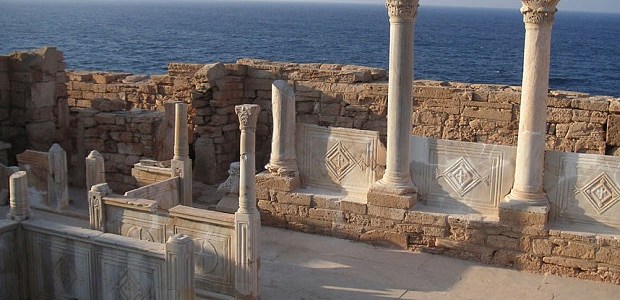
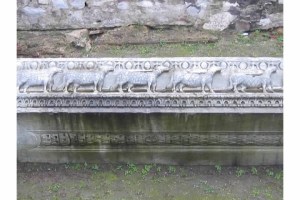
Justinian had such buildings constructed with interlocking pieces that might be be readily shipped and assembled in distant locations – the image above shows the ruins of one such Justinian construct from Libya.  They were transported by specially designed cargo vessels across his restored Roman Empire, and this particular church spent nearly fifteen hundred years on the Mediterranean seabed before it was discovered in the 1960’s.  While many pieces still lie submerged, Oxford will mount the structure with what they have to give museum-goers an opportunity to ‘visit’ a vestige of Justinian’s Rome.

For me, the sheer brilliance of the lego-like, prefabricated concept that Roman engineers invented fifteen centuries ago is an absolute marvel.  Cutting edge architectural magazines like Dwell now expound the pre-fab ‘trend’!   Just imagine Justinian’s ships plying Mare Nostrum fifteen centuries ago with civilization in their holds, exporting tangible proof of Rome’s continued strength long after the West had fallen away.

Click here for an article in the UK Telegraph (loaded with factual inaccuracies but fascinating nonetheless).

Medusa Head Discovered in Turkey

On a hilltop in Turkey’s Antalya province, overlooking the Mediterranean, in what was once the Roman city of Antiochia ad Cragum, a team of archaeologists from the University of Nebraska discovered a remarkable Roman-era Medusa head (see above) below Mount Cragus.

Somehow this pagan symbol survived the Christian-era purges that destroyed so many pagan artifacts.

There is no knowing (yet) as to the date Medusa was carved, but the dig team speculates that she survived the purges because she was part of a building’s facade.

Read here for more.


Belisarius – the “Africanus of New Rome” – in the news

It’s not often that a mainstream blog or news outlet posts something on General Flavius Belisarius so I thought that I would pass along this link to a recent post in the Ancient Origins blog which does a decent job of providing an overview of Belisarius’ life and achievements.

The piece also repeats many of the fallacies pioneered by Sir Edward Gibbon 300 years ago that have been repeated in similar pieces and histories about the Justinian era ever since (i.e. the Roman Empire is the “Byzantine” empire, Romans are”Greeks”, etc.).

That said, it’s entertaining nonetheless for those not familiar with the General.

Please click here for the full article.

And please note that for a fictional account of General Belisarius’ life and times, my Legend of Africanus trilogy in which he figures most prominently is now available on amazon.com here.

9/13/533 – Belisarius and the battle of Ad Decimum

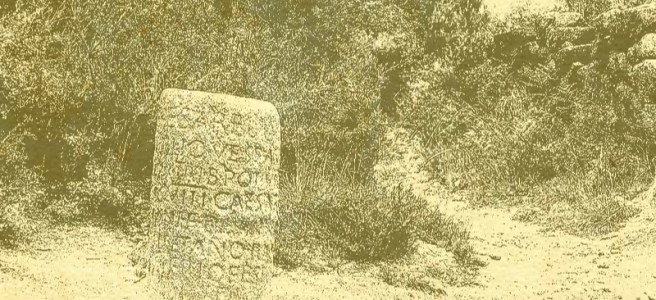
Humble milestones like the one picture above marked each mile throughout the Roman highway system, spanning the 250,000 miles of roadway that once stretched from modern Scotland to Yemen.

The milestones allowed the traveller to know precisely where they stood in relation to their departure point and destination, long before our slavish devotion to smart phones and GPS.

In what had been Roman Africa,  stolen by the Vandals 100 years before, there stood such a stone on the approach to Carthage from the east on the ancient Roman highway that ran along the coast.  It was the tenth milestone from Carthage, known simply as Decimum Miliare (the tenth mile).

At the tenth milestone (Ad Decimum), on September 13th of 533, the Roman Army led by General Flavius Belisarius met the Vandal King Gaiseric in a battle that would change the course of history.

The world fully expected the Romans to fail as Roman armies had failed in the field against the Vandals and their Germanic ‘barbarian’ cousins for generations.  The Romans were 1,000 miles from home – having set sail with an invasion armada for the first time in decades (on ships that were specially built for the purpose since Rome no longer possessed a deep water navy).  If they lost to the Vandals there would be no retreat and no hope of reinforcements.  The Western Roman Empire had already ceased to exist with Romulus Augustulus’ abdication in 476 (in great part due to the Vandal theft of Africa and their brutal sack of the City of Rome).  If Belisarius lost the battle at the tenth milestone, the Eastern Roman Empire would be in grave jeopardy.

Belisarius and his Roman knights would triumph at Decimum Miliare against all odds and went on to extinguish the upstart Vandal kingdom and to bring Africa back into the Roman fold.  This was the first in a string of stunning victories engineered by Belisarius that would restore much of the lost Western Empire in the name of the reigning Caesar, the Emperor Justinian.  These recuperated lands (Africa, Italy, parts of Gaul and Hispania) would remain part of the Roman Empire until after Justinian’s death – the moment when the ancient world truly ended and the Dark Ages began.

This moment, the battle that became known as Ad Decimum, figures prominently in the second book of the Legend of Africanus series: Avenging Africanus (available at amazon.com here).

For those that would like to read more of the military history of Ad Decimum, see the excellent Byzantine Military blog by clicking here.

Happy Anniversary – Justinian “the Great”

On August 1st 527, the old warrior and Roman Emperor, Justin I died in the Imperial capital of Constantinople.

Justin had risen to the throne in 518.  He had previously held the position of Commander of the Excubitors, the elite palace guard, and upon the death of the Emperor Anastasius, Justin was nominated to the purple with the considerable help of his brilliant young nephew, Pietrus Sabbatius.

As Justin’s health failed he named his nephew (now re-christened “Justinian” in honor of his uncle) as co-Emperor in April of 527.

And when Justin died on August 1st, Justinian became sole Emperor, a position that he would hold until his death in November of 565.

So began the Age of Justinian (though he also exerted tremendous influence behind the throne while his Uncle reigned) – a period which continues to impact the world that we live in today.

He would be the last Roman Emperor to speak Latin as his first language, and the last Caesar to rule over an Empire that included the city of Rome in its domains.  Justinian would count many other “lasts”, and many “firsts” amongst his accomplishments though for me what continues to resonate is that as Justinian ascends, the world stands on a razor’s edge, with the Ancient World on one side and the Dark Ages on the other.  Upon his death the passage to the Dark Ages was irrevocably made.