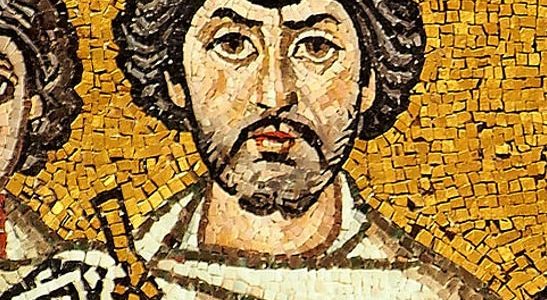
On This Day in 533, Belisarius Avenged Rome’s Honor “Ad Decimum Miliare”

ON THIS DAY IN HISTORY, September 13th 533, the Roman General Flavius Belisarius changed the history of the world by winning an unwinnable battle against the barbarian Vandals in what had once been Roman Africa, at a place known to us as AD DECIMUM, the tenth mile marker…

Humble milestones like the one pictured below marked each mile throughout the Roman highway system, spanning the 250,000 miles of roadway that once stretched from modern Scotland to Yemen. So extraordinarily durable was their construction that a number of those roads (and the bridges they crossed) are still in use today across former Roman territories in Europe, Africa and the Middle East.  Roman mile markers allowed the traveler to know precisely where they stood in relation to their departure point and destination, long before our slavish devotion to smart phones and GPS.
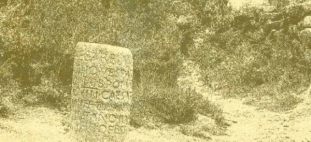
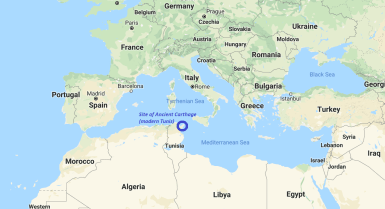
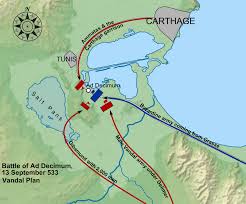
In what had been Roman Africa, stolen by the Vandals 100 years before, there stood such a stone on the approach to Carthage from the east on the ancient Roman highway that ran along the coast. To put this battle into a modern geographical context, note that where Carthage once stood in the ancientworld the sprawling metropolis of Tunis, capital of Tunisia, sits today (see map below). The actual battle took place at the tenth milestone from Carthage, known simply as Decimum Miliare (the tenth mile). This milestone, along with the battlefield itself has not been rediscovered by archaeologists as it lies beneath the suburbs of modern Tunis.


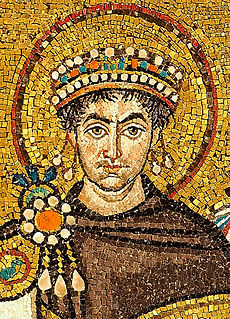
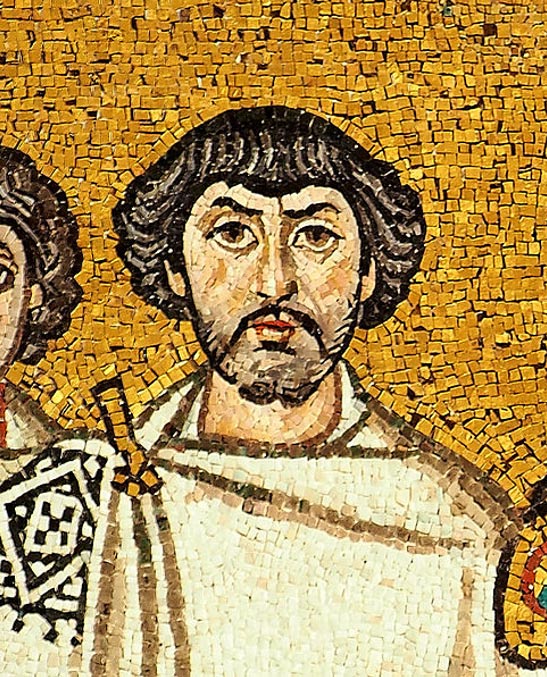
At that now lost tenth milestone (Ad Decimum), on this day – September 13th of 533 – the Roman Army led by General Flavius Belisarius (pictured below) met the Vandal King Gelimer in a battle that would change the course of history.
The world fully expected the Romans to fail as Roman armies had failed in the field against the Vandals and their Germanic ‘barbarian’ cousins for generations. Let’s recall which Romans sailed into battle against the Vandals – these were the Eastern Romans who had managed to avoid the fate that befell the Western Roman Empire for many reasons, not least of which was their geographical distance from the Vandals, Goths, Visigoths and other Northern Barbarians that had extinguished the Western Roman Empire in 476 with the formal abdication of the last Western Emperor, Romulus Augustulus. The Vandal theft of Africa and their brutal sack of the City of Rome were undoubtedly two of the key events that made the loss of the West inevitable.

Now these Eastern Romans sailed straight towards mortal danger over 1,000 miles from home – having set sail with an invasion armada for the first time in decades (on ships that were specially built for the purpose since Rome no longer possessed a deep water navy). If they lost to the Vandals there would be no retreat and no hope of reinforcements. If Belisarius lost the battle at the tenth milestone, the Eastern Roman Empire would be in grave jeopardy.  See below for something of Belisarius’ battle plan at Ad Decimum.


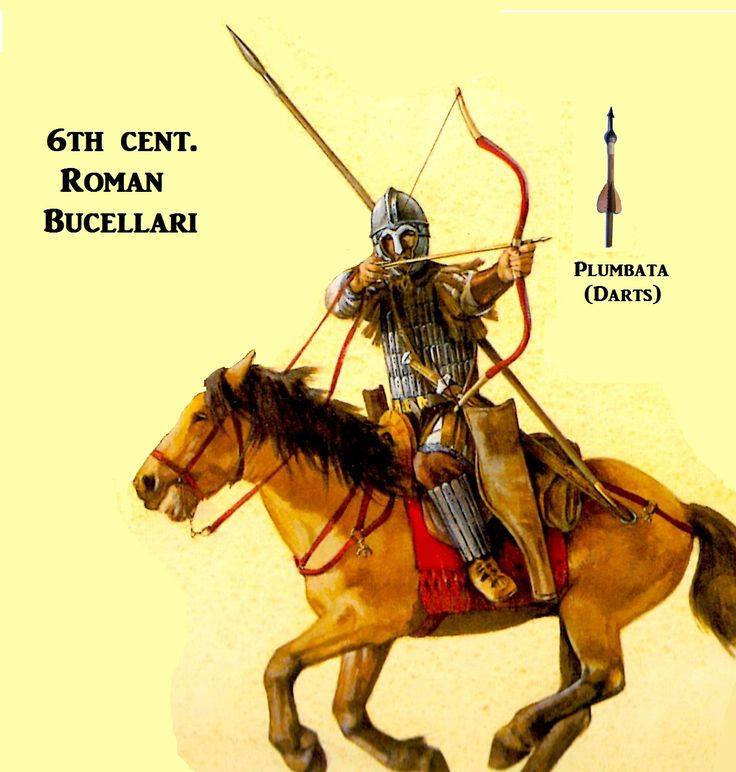
Belisarius and his Roman knights (see an image below for the decidedly medieval looking Roman knight that was very much the product of Belisarius’ experimentation with military technology and tactics) would triumph at Decimum Miliare against all odds and went on to extinguish the upstart Vandal kingdom and to bring Africa back into the Roman fold.


This was the first in a string of stunning victories engineered by Belisarius that would restore much of the lost Western Empire in the name of the reigning Caesar, the Emperor Justinian. These recuperated lands (Africa, Italy, parts of Gaul and Hispania) would remain part of the Roman Empire until after Justinian’s death – the moment when the ancient world truly ended and the Dark Ages began.
This moment, the battle that became known as Ad Decimum, figures prominently in the second book of my Legend of Africanus series: Avenging Africanus (available at amazon.com).
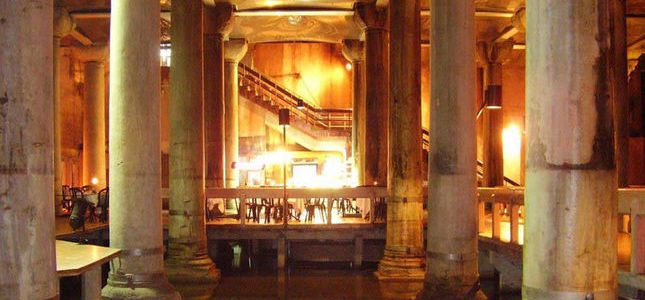
Restoration of Justinian’s Basilica Cistern

Exciting news emerged this week from the world of Archaeology pertaining Mosaic_of_Iustinianus_I_-_Basilica_San_Vitale_(Ravenna)to the Emperor Justinian the Great and one of the greatest Roman feats of engineering and architecture still standing (albeit underground).
 
Anyone who has ever visited Istanbul has surely visited the Basilica Cistern, known in Turkish as the “Yerebatan Sarnıcı”. Located across the street and 645x400-basilica-cistern-set-for-comprehensive-restoration-1483481203740 underground from the Hagia Sophia in the heart of what once was Constantinople – capital of the Roman Empire for one thousand years and before that it was the Greek colony of Byzantium – the Cistern is an architectural marvel completed by the Emperor Justinian the Great (though it was likely begun during the reign of his uncle, the Emperor Justin).
 
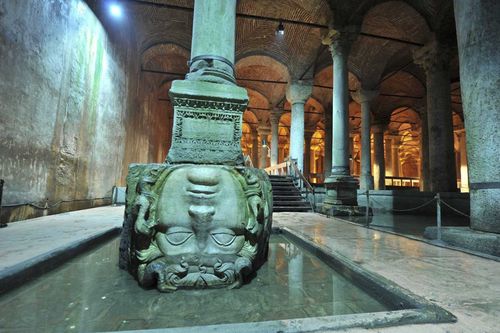
The cistern was built to hold water that might keep the city’s thirst quenched in the event of siege or drought – though it was one of many that littered the city it was far and away the most important. But to call it a reservoir is to do it a grave injustice. It is a work of grace and beauty, built underneath the city streets in the heart of Constantinople. To enter it is to enter a magical space, in some ways (to me at least) it feels as ethereal and transcendent as the grand basilica above. The roof that towers above is supported by 336 columns rising 30 plus feet into the air, reflected in the water that still partially fills the room. A number of those columns contain recycled elements, including 0x0-basilica-cistern-set-for-comprehensive-restoration-1483481201380masonry that the Romans recovered from the more ancient Greek city of Byzantium like the absolutely breathtaking Medusa heads that form the base of two columns (see picture to the right).
 
To walk into the Cistern is to step 2,000 years back in time to the last era of the Romans when they still possessed the technological expertise, capital, and desire to build truly monumental works. Imagine that this place (pictures below) was never built to be seen, to entertain visitors, to awe tourists – it was simply built to hold water! Could we build something so regal today even if we tried? Its hard to contemplate. One cannot look at such a thing and wonder about, and to be awed by, the civilization that was capable of creating it.
 
So, the news this week is that Turkey will embark upon an ambitious restoration of the Cistern (along with the Milion that rests above it – the mile-marker from which all distances in the Empire were measured since Old Rome was lost to the Goths). One cannot help but wish them well and hope that the restoration is done with tact.
 
For more on the restoration see here
 

A Ghost from Caesarea…

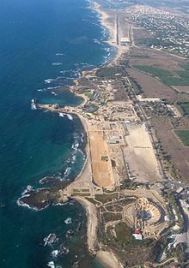
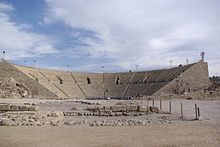
220px-CaesareaA pile of marble, concrete and sandstone sits off a highway between Haifa and Tel Aviv.
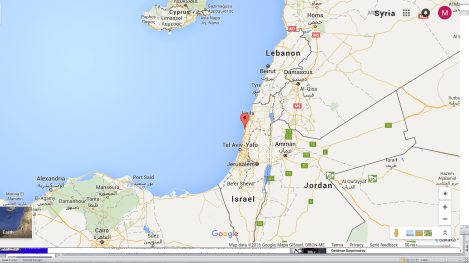
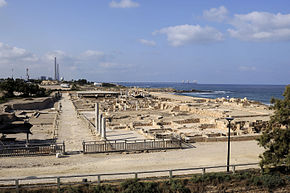
Once a city.

Once a Roman colony, its residents Roman citizens, one of the most important cities in the Roman orbit.

Colonia Prima Flavia Augusta Caesarea.


Named after the first Emperor, Caesar Augustus, the city sat on the turquoise Mediterranean coast in Rome’s Palestina province and dominated Mare Nostrum’s waters, a beacon in the Roman east for many centuries.

Caesarea's location on the Mediterranean

The city had many distinguishing features but none more remarkable than its massive, man-made harbor, the biggest in the world when it was built enclosing 100,000 square meters. It was known as Sebastos Harbor (“sebastos” from the Greek for Augustus), and its construction was made possible by the Caesarea_maritima_(DerHexer)_2011-08-02_098 220px-Caesarea_maritima_BW_4Roman’s brilliant invention of a new kind of concrete upon which they built their world-spanning Empire. A mix of lime and pozzolana (volcanic ash imported from Italy), this almost indestructible concrete has the unique quality of growing harder with time – even underwater – one of the reasons why there are so many well preserved Roman maritime ruins in the world.

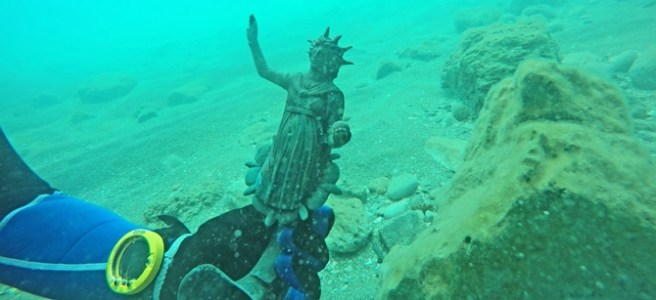
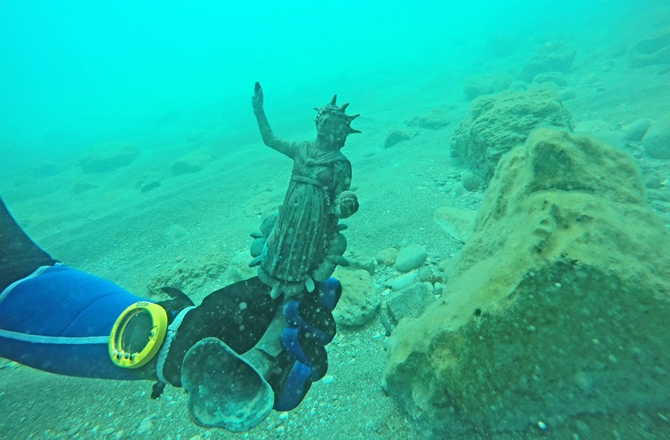
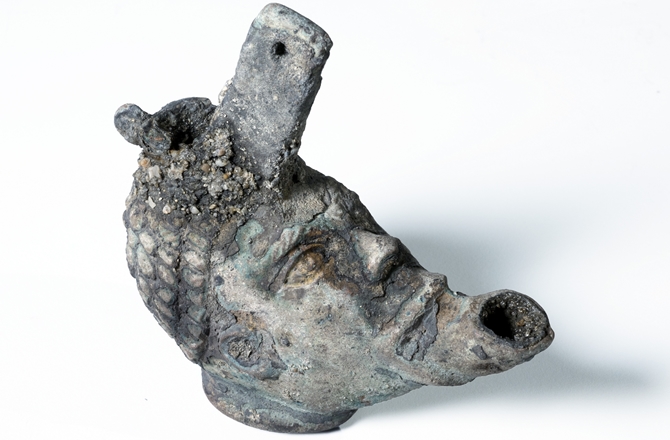
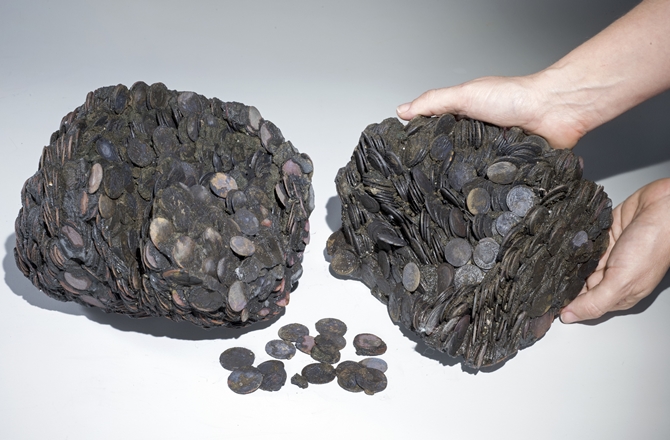
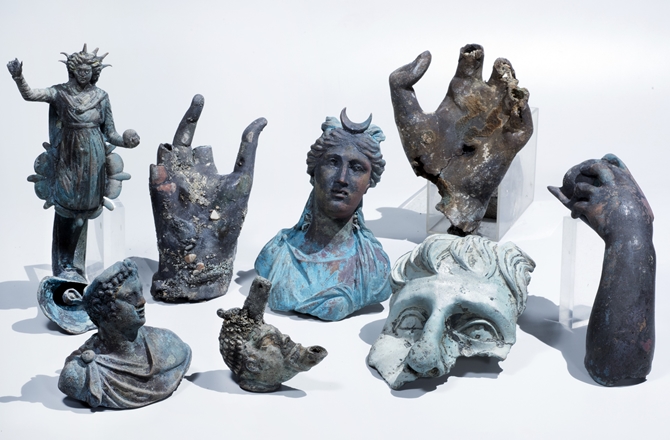
Recently, somewhere in those waters off Caesarea, two divers discovered an ancient Roman wreck, a ship that sunk in the age of Constantine the Great – 1,600 years ago. IAA (Israel Antiquities Authority) archaeologists who explored the wreck speculate that the ship must have foundered when trying to make the harbor in a storm, depositing its cargo in the sand where it has been well preserved for nearly two millennium.

Among its contents were exceptional statues, including one of the Moon Goddess Luna (see below) that’s as beautiful as any I have seen, a grand collection of Roman coins, anchors, and other metal objects that were bound for recycling according to the IAA. Thanks to the storm they never made it to the foundry, giving us one of the most important maritime discoveries of Roman artifacts in Israel in the last three decades.

DCIM100GOPROGOPR4486.
DCIM100GOPROGOPR4481.

04-israel-shipreck 07-israel-shipreck coins 09-israel-shipreck statues

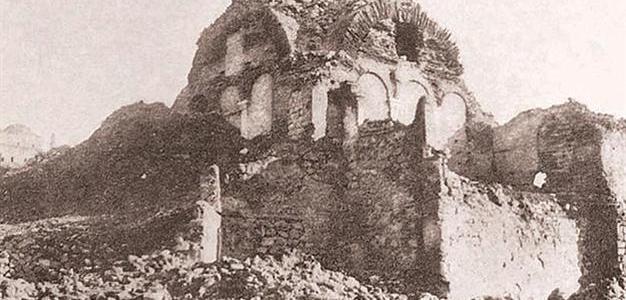
Last Roman church in Ankara (Turkey) close to disappearing

Saint Clement - ruins

It’s easy to forget that all of Turkey was once the heart of the Roman Empire after the far-sighted Emperor Constantine moved the Empire’s capital from Italy to Turkey (to Byzantium-Constantinople-Nova Roma-Istanbul).

Yet evidence of Rome’s presence in Turkey (not to mention Syria/Libya/Israel/Egypt/Algeria etc.) is everywhere, sitting patiently in the shadows, enduring benign and not so benign neglect by the country’s current government.

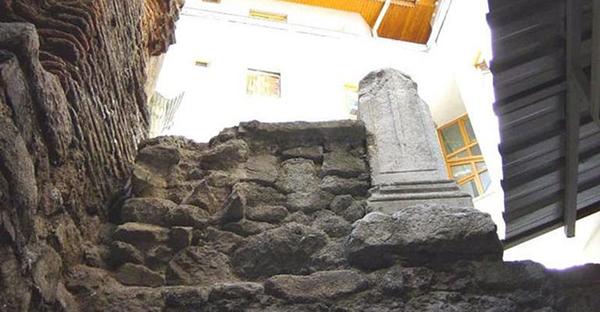
Hence this intriguing article.  There seems to be a rebirth of interest in Turkey’s Roman past among academics and ordinary citizens, and a growing movement to preserve and promote that past.  As you will see in the link below, the paper, Hurriyet, references what appears to be the last Roman church where traces (ruins) are still visible in the capital of modern Turkey, Ankara – far from Istanbul / Constantinople, wedged in between modern buildings, almost forgotten and rapidly disappearing.

The article speculates that the church known as Saint Clement’s was built as early as the 4th century, and the paper calls for the Roman building to be preserved.  From a glimpse at the picture above, one cannot help but hope that the call to action is heeded.  Saint Clement the man (and the structure) is described by Wikipedia as:

In 303, Ancyra was one of the towns where the co-Emperors Diocletian and his deputy Galerius launched their anti-Christian persecution. In Ancyra, their first target was the 38-year-old Bishop of the town, whose name was Clement. Clement’s life describes how he was taken to Rome, then sent back, and forced to undergo many interrogations and hardship before he, and his brother, and various companions were put to death. The remains of the church of St. Clement can be found today in a building just off Işıklar Caddesi in the Ulus district. Quite possibly this marks the site where Clement was originally buried.

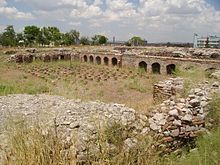
Other Roman structures still exist in Ankara, including traces of the Roman Baths below.  See this Wikipedia on Roman Ankara for more on Ankara’s Roman past.

220px-AnkaraRomanBaths1


Roman Mosaic Floor Found in Turkey, near Syria

“The city is one of the few places where Syrian urban culture from the Hellenistic-Roman era can currently still be studied.” – Prof. Dr. Engelbert Winter from University of Münster

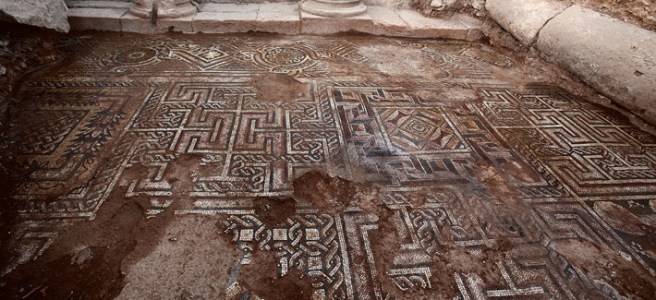
Archaeologists from Germany’s University of Munster have discovered a beautiful mosaic floor in Gaziantep, Turkey (just 60 miles from Aleppo, Syria),. once known as Doliche in Rome’s Syrian province.

This part of Turkey is one of the last protected parts of this once flourishing region of the Roman Empire.  Most of Roman Syria is now off-limits and under assault, as per the lead quote above making this corner of Turkey, and this find, that much more valuable.

Though the date in which the floor was set has not yet been disclosed it is of a late Roman vintage and very reminiscent of work seen in Istanbul’s Great Palace Mosaic Museum (once Constantinople’s Imperial Palace).

For more on the discovery see this link to the University of Munster’s press release.


Justinian Era Mosaics found in Israel

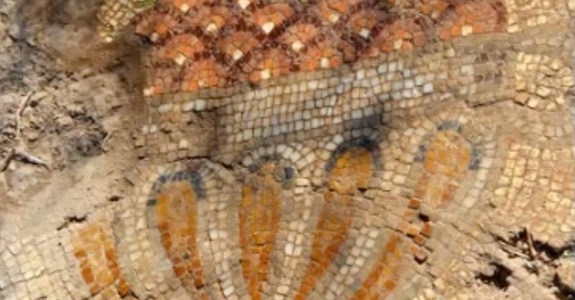
The Israel Antiquities Authority just released pictures of marvelous mosaics found in an industrial park in Qiryat Gat, Israel – they once graced the floor of a church likely built in Justinian’s lifetime, featuring christian and more traditional (pagan) images.  Curiously, the mosaics also depicted a map of an Egyptian city – Chortaso – which might have been the original home of this congregation though the true meaning of the map is a mystery.

Why would a church in Judaea have a map of a town in Egypt gracing its floor?

See here for more:

http://www.livescience.com/52335-photos-ancient-church-mosaic.html


Romans in Germany!

Nothing gets my juices flowing like a new archaeological find that illustrates the breathtakingly broad reach of Imperial Rome.

Though this doesn’t date to the era of Rome on the Cusp, this little find is fascinating nonetheless.

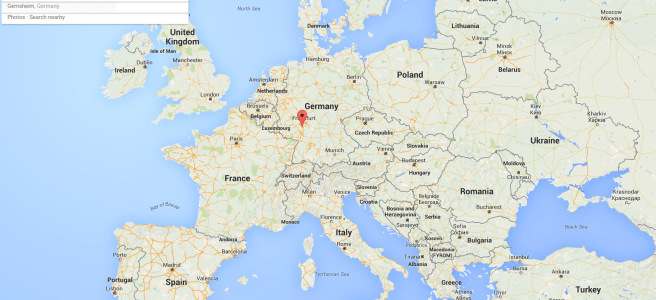
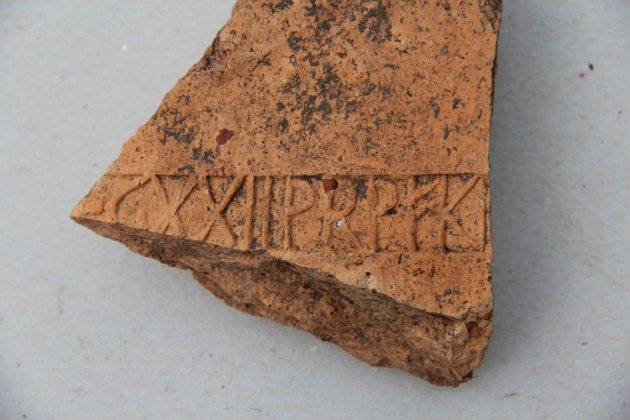
Near the modern town of Gernsheim (on the Rhine River), archaeologists from Goethe University just discovered an early 2nd century Roman fort.  They estimate that it was abandoned around 120CE when the soldiers stationed there were moved to the Roman frontier with Germania along the Danube.  Found in the dig thus far are signs of ordinary life, dice, combs, etc. and a masonry fragment indicating the name of the unit stationed there (see below), the Legio XXII Primigenia Pia Fidelis, part of the Limes Germanicus.

gernsheim find

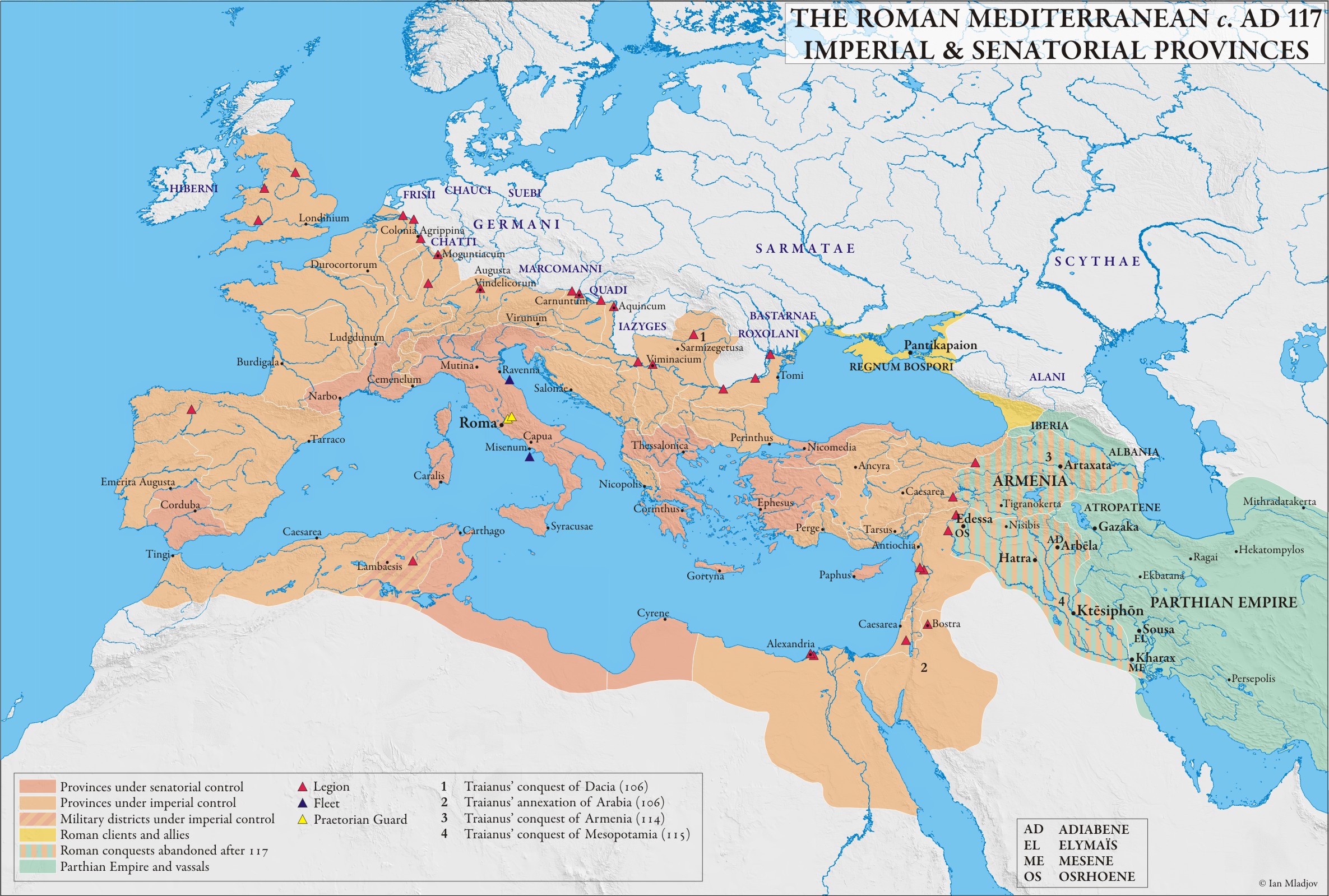
Here is a reminder of what the Roman Empire looked like at that date.

romana117

And here is a brief article on the dig in Archaeology.

And a better article in the International Business Tribune.

Ancient Rome vs. Istanbul’s New Subway

“Oh, some archaeological crockery turned up—oh, some finding turned up,” he told the press. “That’s how they put obstacles in our path. Are these things really more important than the human?”

Turkish Prime Minister Erdogan on the archaeological dig in what once was Constantinople’s Eleutherion Harbor

Istanbul – Nova Roma – Constantinople – BYZANTIUM.

Few more fascinating places exist on the face of the planet, layered with history and culture, teeming with life, speeding into the future.

As part of that race, in 2004, Turkey revived Ottoman-era plans to build a tunnel beneath the Bosporus to accommodate a subway line (prior to the tunnel the only way to cross the Bosporus was via ferry or over one of two bridges).  Having lived in Istanbul, I can testify to the city’s remarkably bad traffic (which is getting worse – when I left in ’98 the city had 9 million residents, today that number is 14 million).

In an effort to avoid burrowing through the historic district of Sultanahmet for the subway (formerly the heart of both Greek-Byzantium and Roman-Constantinople), the tunnel’s designers chose the modern neighborhood of Yenikapi (that was built on reclaimed land that had once been water) for the subway’s principal European stop.

However that reclaimed land upon which Yenikapi was built was of particular significance to the city’s Roman era – it had once been known as Eleutherion Harbor (or the ‘Theodosian Harbor’), one of the Imperial city’s principal harbors during its early days as the capital of the Roman Empire and through Justinian’s era.  However, with time it silted over and was eventually abandoned in the city’s later Roman period.

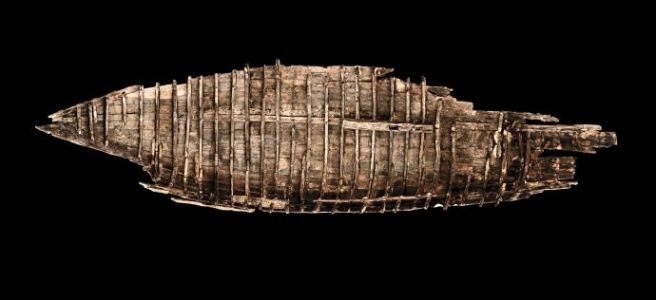
Once Istanbul’s Big Dig began it quickly became clear that Yenikapi contained a Roman treasure trove including some of the best preserved Roman ships of war ever found (many from Justinian-era Rome including the featured image above) and a piece of Constantine’s original city wall.  Additional excavations unearthed previously unknown Neolithic settlements dating to 6000 BC (the earliest known settlements prior to this discovery dated to ~1,300 BC).

The superb Istanbul Archaeology Museum was brought in to monitor and control the dig, resulting in many of these exceptional finds being preserved for future study – a process that will take decades given the scale of the finds.  Having the Museum involved in the process (fortunately) resulted in an equally exceptional delay to the dig which was just completed in 2014 (raising hackles in the Turkish government as per lead quote above).

See an interesting article in the current New Yorker that does a good job of summarizing the Tunnel project, the associated politics and the stunning discoveries that resulted from it all.

http://www.newyorker.com/magazine/2015/08/31/the-big-dig

For more on the Istanbul Archaeology Museum see here:

http://www.istanbularkeoloji.gov.tr/main_page

Nero’s Golden House

A house whose size and elegance these details should be sufficient to relate: Its courtyard was so large that a 120-foot colossal statue of the emperor himself stood there; it was so spacious that it had a mile-long triple portico; also there was a pool of water like a sea, that was surrounded by buildings which gave it the appearance of cities; and besides that, various rural tracts of land with vineyards, cornfields, pastures, and forests, teeming with every kind of animal both wild and domesticated. In other parts of the house, everything was covered in gold and adorned with jewels and mother-of-pearl; dining rooms with fretted ceilings whose ivory panels could be turned so that flowers or perfumes from pipes were sprinkled down from above; the main hall of the dining rooms was round, and it would turn constantly day and night like the Heavens; there were baths, flowing with seawater and with the sulfur springs of the Albula; when he dedicated this house, that had been completed in this manner, he approved of it only so much as to say that he could finally begin to live like a human being.  Suetonius, The Lives of the Caesars

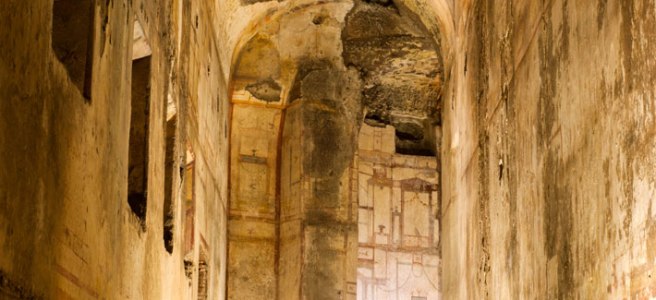
An intriguing piece appeared in this month’s “Archaeology Magazine” on Nero’s Domus Aurea or “Golden House” that has been undergoing a painstaking and extended renovation.  After the tyrant Nero’s death the Roman Senate had this sprawling city-within-the-city filled with earth and buried so that the dictator’s memory too would be submerged (but never forgotten).  Spanning the area between the Palatine and Esquiline hills in Rome (where the Colosseum stands today) – the scale of the structure and its contents are difficult to fathom.  On a side note, the Flavian Amphitheatre took its colloquial name, the Colosseum from the hundred foot tall statue of the “Colossus”  as the stature of Nero on the grounds of his Golden House was known.

The Domus Aurea stood for four years after completion before it was buried in 69CE following the Emperor’s death.  And it slept peacefully underground until the Renaissance when a boy fell through the roof into the halls below in the 15th century.  A generation of some of the great artists of the period including Raphael heard of the chance discovery and had themselves lowered by rope into the palace through holes drilled in the roof (contributing greatly to the subsequent damage that archeologists today are trying mightily to undo).  While its difficult to say how these glimpses of the ancient world influenced them one can begin to imagine as we look at the stunning Domus Aurea today.

I couldn’t help but think, as I read the article, that as these Renaissance pioneers were rediscovering an ancient world in the West that had been lo200px-Constantine_XI_Palaiologos_miniaturest for so many centuries, in Constantinople at that same
approximate time the very last Caesar, the Emperor Constantine XI (see contemporary image at right) was battling Mehmed the Conqueror to prevent the fall of Constantinople that would finally and forever extinguish what remained of the Roman Empire.  I am fascinated by this contrast, artists in the West re-learning, rediscovering their patrimony and in the East, a flickering light finally extinguished.  Incidentally, the Fall of the East that ensued when Mehmed breached the Theodosian Walls of Constantinople made the Renaissance possible, flooding Italy with scholars, artists and philosophers and the contents of the world’s greatest libraries from Constantinople that had kept the flame of ancient Greece, Rome and Persia alive while the rest of Europe had wallowed in centuries of darkness and comparative ignorance.

Here is a link to the article on the Domus Aurea in Archeology Magazine:

http://www.archaeology.org/issues/187-1509/features/3562-golden-house-of-an-emperor

And for those interested in learning a bit more about the Last Roman Emperor, Constantine XI, who will appear prominently in my next novel (now being researched), please see this fair summary in Wikipedia:

https://en.wikipedia.org/wiki/Constantine_XI_Palaiologos