Roman Gardens in Istanbul, Under Siege

Amateur gardeners (myself included), eat your heart out…

On the fringes of Istanbul’s Theodosian walls, in the neighborhood of Yedikule, the residents of Byzantium / Constantinople / Istanbul have been cultivating gardens on the same plots of lands for nearly 2000 years, since before the city walls were built by the Roman Emperor Theodosius II (408-450CE) – a restored section of the Wall near in Yedikule is pictured below.
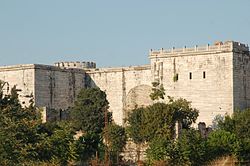
Theodosian_Golden_Gate


The first gardeners were likely the Greek Byzantines, then the Romans, then the Ottomans / Turks and most recently, migrants from Turkey’s Black Sea region and most recently, Syrian and Afghan refugees. Throughout the gardens’ 2000 years history many of the same crops have been grown as the gardeners themselves have changed including cabbage, beets, carrots, onions, turnips among other crops.

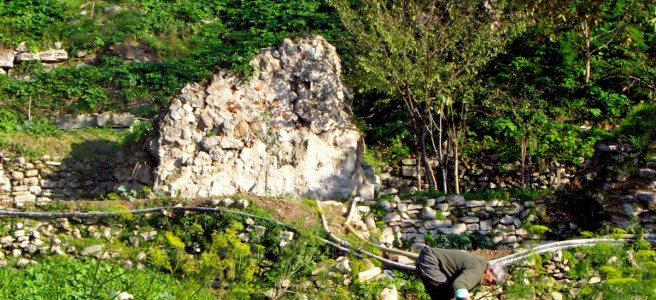
Sadly, these ancient gardens, or ‘bostan’ as they are known in Turkish are under threat from the swelling population of the city (now topping 16 million from the 9 million residents when I lived here in the late 90’s). Underutilized land across the city is being consumed by sprawl, and many of these ancient gardens / ‘bostan’ have already succumbed.  Below is a picture of one patch of Yedikule’s bostan.


Yet a growinYedikule Gardensg movement in Istanbul recognizes the cultural and environmental value of these remarkable gardens and are fighting to preserve them.
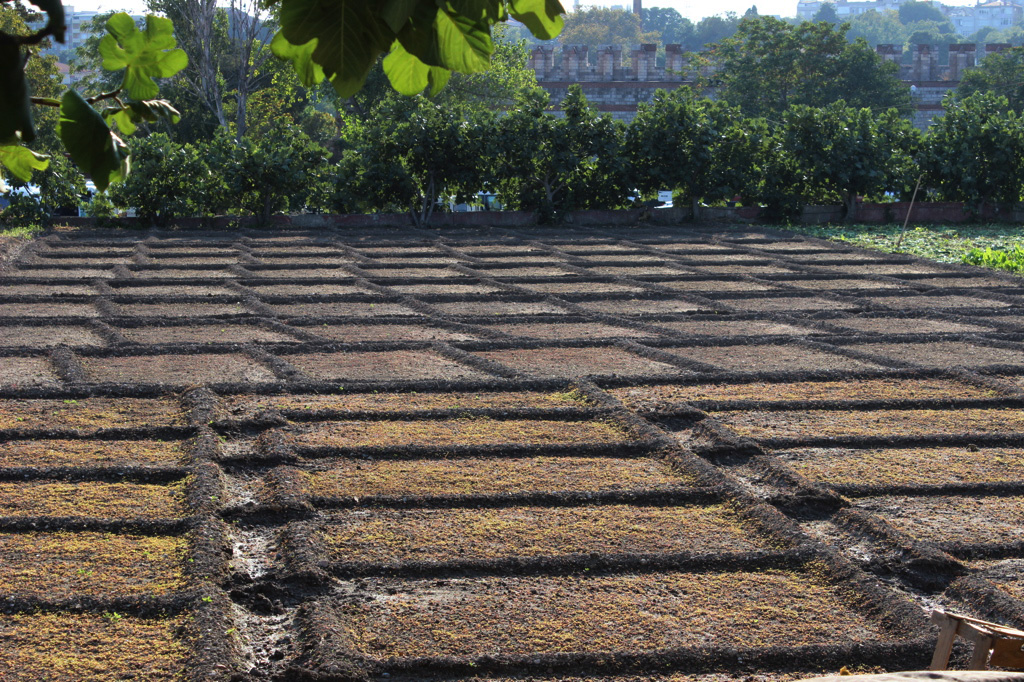
See this article in Yale University’s “Environment 360” newsletter for more on this fascinating issue.


Ancient Roman Tavern found in France

It doesn’t look like much in the picture above, but this restaurant just unearthed in Southern France has archaeologists quite excited.  It is located in what was once the Roman seaside town of Lattara, and two millenia ago it catered to local diners as well as Roman immigrants that had settled in the area.  Few such Roman taverns have been found making this discovery particularly compelling.  Archaeologists have concluded that the restaurant made its own bread, served food and in an adjacent space they served libations as well (traces of alcohol have been identified in bowls imported from Italy for that purpose).

For more on this discovery see Archaeology Magazine.

Lattes_-_Musée_Henri-Prades_-_Vue_du_site_archéologique_de_Lattara

And for more on the port city of Littara (remains pictured below) see the website for the local museum, Henri Prades of Montpellier Méditerranée Métropole in Lattes.

Swiss Cherry Farmer finds Roman Coin Hoard (in a mole hill)

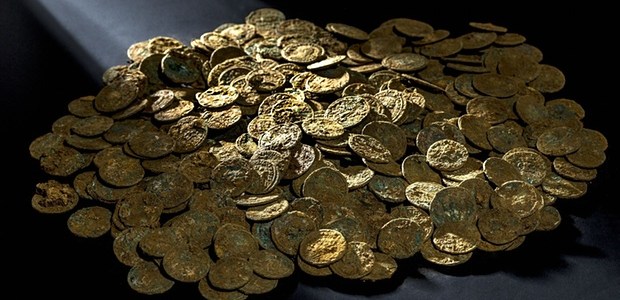
A Swiss farmer found a hoard of 4,166 Roman coins in a mole hill beneath his cherry orchard recently.  The 1,700 year old coins were in fantastic condition, the most recent of which dates to the reign of the Emperor Maximilian (buried shortly after it was minted in the year 294CE).  Their pristine condition was in part attributed to the fact that the land in which they were deliberately buried had never been built upon – it has been continuously farmed since this part of Switzerland was part of the Roman Empire.

Click here for more.


Justinian’s “Flat-Pack” Church, Raised from the Seabed

“We hope it will be easier [to assemble] than an Ikea wardrobe.”
– Dr Alexander Sturgis, Oxford University

A prefabricated church, built in Justinian’s Constantinople and lost at sea off the coast of Sicily 1,500 years ago will soon be reassembled in Oxford University’s Ashmolean Museum.

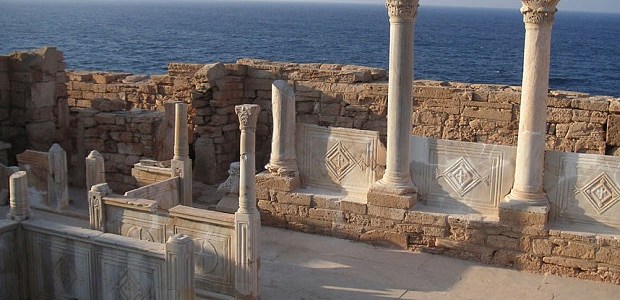
Justinian had such buildings constructed with interlocking pieces that might be be readily shipped and assembled in distant locations – the image above shows the ruins of one such Justinian construct from Libya.  They were transported by specially designed cargo vessels across his restored Roman Empire, and this particular church spent nearly fifteen hundred years on the Mediterranean seabed before it was discovered in the 1960’s.  While many pieces still lie submerged, Oxford will mount the structure with what they have to give museum-goers an opportunity to ‘visit’ a vestige of Justinian’s Rome.

For me, the sheer brilliance of the lego-like, prefabricated concept that Roman engineers invented fifteen centuries ago is an absolute marvel.  Cutting edge architectural magazines like Dwell now expound the pre-fab ‘trend’!   Just imagine Justinian’s ships plying Mare Nostrum fifteen centuries ago with civilization in their holds, exporting tangible proof of Rome’s continued strength long after the West had fallen away.

Click here for an article in the UK Telegraph (loaded with factual inaccuracies but fascinating nonetheless).

Roman Mosaic Floor Found in Turkey, near Syria

“The city is one of the few places where Syrian urban culture from the Hellenistic-Roman era can currently still be studied.” – Prof. Dr. Engelbert Winter from University of Münster

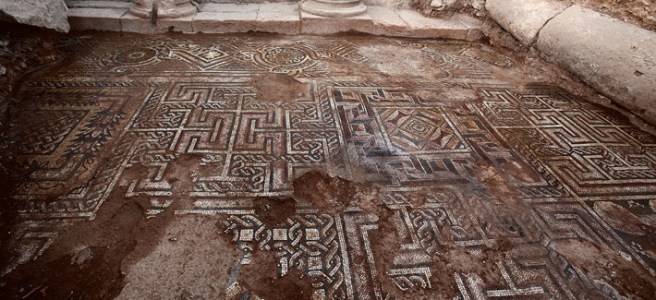
Archaeologists from Germany’s University of Munster have discovered a beautiful mosaic floor in Gaziantep, Turkey (just 60 miles from Aleppo, Syria),. once known as Doliche in Rome’s Syrian province.

This part of Turkey is one of the last protected parts of this once flourishing region of the Roman Empire.  Most of Roman Syria is now off-limits and under assault, as per the lead quote above making this corner of Turkey, and this find, that much more valuable.

Though the date in which the floor was set has not yet been disclosed it is of a late Roman vintage and very reminiscent of work seen in Istanbul’s Great Palace Mosaic Museum (once Constantinople’s Imperial Palace).

For more on the discovery see this link to the University of Munster’s press release.


Medusa Head Discovered in Turkey

On a hilltop in Turkey’s Antalya province, overlooking the Mediterranean, in what was once the Roman city of Antiochia ad Cragum, a team of archaeologists from the University of Nebraska discovered a remarkable Roman-era Medusa head (see above) below Mount Cragus.

Somehow this pagan symbol survived the Christian-era purges that destroyed so many pagan artifacts.

There is no knowing (yet) as to the date Medusa was carved, but the dig team speculates that she survived the purges because she was part of a building’s facade.

Read here for more.


Belisarius – the “Africanus of New Rome” – in the news

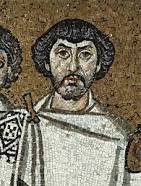
It’s not often that a mainstream blog or news outlet posts something on General Flavius Belisarius so I thought that I would pass along this link to a recent post in the Ancient Origins blog which does a decent job of providing an overview of Belisarius’ life and achievements.

The piece also repeats many of the fallacies pioneered by Sir Edward Gibbon 300 years ago that have been repeated in similar pieces and histories about the Justinian era ever since (i.e. the Roman Empire is the “Byzantine” empire, Romans are”Greeks”, etc.).

That said, it’s entertaining nonetheless for those not familiar with the General.

Please click here for the full article.

And please note that for a fictional account of General Belisarius’ life and times, my Legend of Africanus trilogy in which he figures most prominently is now available on amazon.com here.

9/13/533 – Belisarius and the battle of Ad Decimum

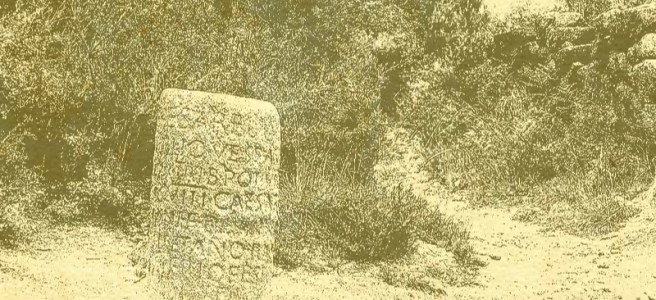
Humble milestones like the one picture above marked each mile throughout the Roman highway system, spanning the 250,000 miles of roadway that once stretched from modern Scotland to Yemen.

The milestones allowed the traveller to know precisely where they stood in relation to their departure point and destination, long before our slavish devotion to smart phones and GPS.

In what had been Roman Africa,  stolen by the Vandals 100 years before, there stood such a stone on the approach to Carthage from the east on the ancient Roman highway that ran along the coast.  It was the tenth milestone from Carthage, known simply as Decimum Miliare (the tenth mile).

At the tenth milestone (Ad Decimum), on September 13th of 533, the Roman Army led by General Flavius Belisarius met the Vandal King Gaiseric in a battle that would change the course of history.

The world fully expected the Romans to fail as Roman armies had failed in the field against the Vandals and their Germanic ‘barbarian’ cousins for generations.  The Romans were 1,000 miles from home – having set sail with an invasion armada for the first time in decades (on ships that were specially built for the purpose since Rome no longer possessed a deep water navy).  If they lost to the Vandals there would be no retreat and no hope of reinforcements.  The Western Roman Empire had already ceased to exist with Romulus Augustulus’ abdication in 476 (in great part due to the Vandal theft of Africa and their brutal sack of the City of Rome).  If Belisarius lost the battle at the tenth milestone, the Eastern Roman Empire would be in grave jeopardy.

Belisarius and his Roman knights would triumph at Decimum Miliare against all odds and went on to extinguish the upstart Vandal kingdom and to bring Africa back into the Roman fold.  This was the first in a string of stunning victories engineered by Belisarius that would restore much of the lost Western Empire in the name of the reigning Caesar, the Emperor Justinian.  These recuperated lands (Africa, Italy, parts of Gaul and Hispania) would remain part of the Roman Empire until after Justinian’s death – the moment when the ancient world truly ended and the Dark Ages began.

This moment, the battle that became known as Ad Decimum, figures prominently in the second book of the Legend of Africanus series: Avenging Africanus (available at amazon.com here).

For those that would like to read more of the military history of Ad Decimum, see the excellent Byzantine Military blog by clicking here.

9/4/476 – Romulus Augustulus, Last Western Roman Emperor, Abdicates

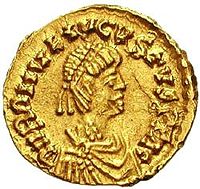
On this day (September 4th) in 476CE, the last Western Roman Emperor, Romulus Augustulus, was deposed by the Goth warlord Odoacer.

When Romulus, who was little more than a boy, stepped down from the throne in Ravenna (then capital of the Western Empire), Odoacer took the Imperial regalia and sent it to the Eastern Emperor, Zeno, claiming that Italy no longer needed a Caesar and that the Goths would rule Italy in Zeno’s name, as his vassals.

It’s a fascinating moment in time, one often misinterpreted as marking the “fall” of Rome – a fallacy created in large part by the great historian Edward Gibbon.  The truth is much more complex!

In reality the Western Empire had ceased to exist, in all but name, decades before.  Yet at the same time the essence of Rome would continue in its former Western territories for centuries to come.  And Italy herself would be brought formally back into the Empire during the reign of Justinian, thanks to the extraordinary efforts of General Flavius Belisarius.  There she would remain until after Justinian’s death.

Nonetheless, the day the boy Emperor abdicated and retired to live peacefully on a Goth-provided pension in the Castellum Lucullanum at Neapolis (Naples) was indeed a turning point in human history and deserves to be remembered.

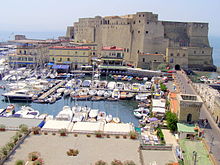
On a final note, though the Roman fortifications on the site were subsequently replaced by the Normans in the 12th century (see image to the right)Il_Castello_dell'Ovo_In_Napoli, one can’t help but imagine the melancholic Caesar looking out from the battlements, dreaming of Empire lost…

Though nothing is known of Romulus’ death he could not have lived to have witnessed Belisarius’ reconquest of Italy (completed in in 540CE).

Following is a post in today’s “New Historian” for those looking for more on the Last Western Emperor.

http://www.newhistorian.com/romulus-augustus-deposed-by-odoacer/4754/