Ancient Rome vs. Istanbul’s New Subway

“Oh, some archaeological crockery turned up—oh, some finding turned up,” he told the press. “That’s how they put obstacles in our path. Are these things really more important than the human?”

Turkish Prime Minister Erdogan on the archaeological dig in what once was Constantinople’s Eleutherion Harbor

Istanbul – Nova Roma – Constantinople – BYZANTIUM.

Few more fascinating places exist on the face of the planet, layered with history and culture, teeming with life, speeding into the future.

As part of that race, in 2004, Turkey revived Ottoman-era plans to build a tunnel beneath the Bosporus to accommodate a subway line (prior to the tunnel the only way to cross the Bosporus was via ferry or over one of two bridges).  Having lived in Istanbul, I can testify to the city’s remarkably bad traffic (which is getting worse – when I left in ’98 the city had 9 million residents, today that number is 14 million).

In an effort to avoid burrowing through the historic district of Sultanahmet for the subway (formerly the heart of both Greek-Byzantium and Roman-Constantinople), the tunnel’s designers chose the modern neighborhood of Yenikapi (that was built on reclaimed land that had once been water) for the subway’s principal European stop.

However that reclaimed land upon which Yenikapi was built was of particular significance to the city’s Roman era – it had once been known as Eleutherion Harbor (or the ‘Theodosian Harbor’), one of the Imperial city’s principal harbors during its early days as the capital of the Roman Empire and through Justinian’s era.  However, with time it silted over and was eventually abandoned in the city’s later Roman period.

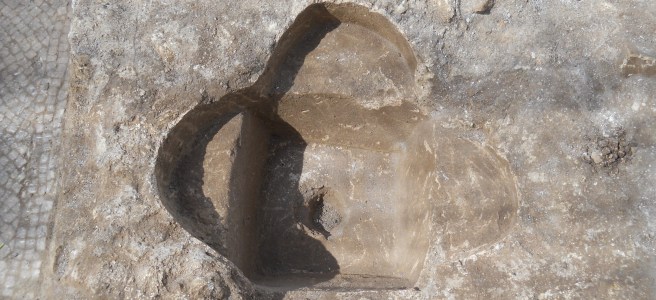
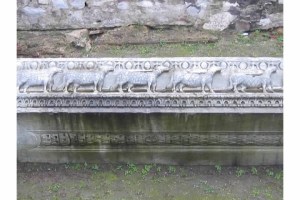
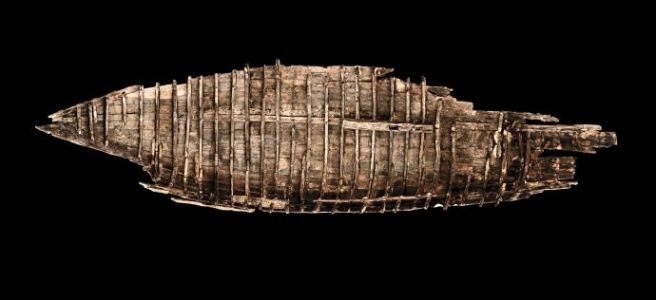
Once Istanbul’s Big Dig began it quickly became clear that Yenikapi contained a Roman treasure trove including some of the best preserved Roman ships of war ever found (many from Justinian-era Rome including the featured image above) and a piece of Constantine’s original city wall.  Additional excavations unearthed previously unknown Neolithic settlements dating to 6000 BC (the earliest known settlements prior to this discovery dated to ~1,300 BC).

The superb Istanbul Archaeology Museum was brought in to monitor and control the dig, resulting in many of these exceptional finds being preserved for future study – a process that will take decades given the scale of the finds.  Having the Museum involved in the process (fortunately) resulted in an equally exceptional delay to the dig which was just completed in 2014 (raising hackles in the Turkish government as per lead quote above).

See an interesting article in the current New Yorker that does a good job of summarizing the Tunnel project, the associated politics and the stunning discoveries that resulted from it all.

http://www.newyorker.com/magazine/2015/08/31/the-big-dig

For more on the Istanbul Archaeology Museum see here:
http://www.istanbularkeoloji.gov.tr/main_page

Nero’s Golden House

A house whose size and elegance these details should be sufficient to relate: Its courtyard was so large that a 120-foot colossal statue of the emperor himself stood there; it was so spacious that it had a mile-long triple portico; also there was a pool of water like a sea, that was surrounded by buildings which gave it the appearance of cities; and besides that, various rural tracts of land with vineyards, cornfields, pastures, and forests, teeming with every kind of animal both wild and domesticated. In other parts of the house, everything was covered in gold and adorned with jewels and mother-of-pearl; dining rooms with fretted ceilings whose ivory panels could be turned so that flowers or perfumes from pipes were sprinkled down from above; the main hall of the dining rooms was round, and it would turn constantly day and night like the Heavens; there were baths, flowing with seawater and with the sulfur springs of the Albula; when he dedicated this house, that had been completed in this manner, he approved of it only so much as to say that he could finally begin to live like a human being.  Suetonius, The Lives of the Caesars

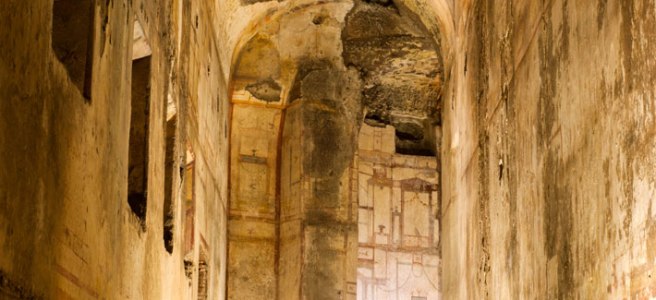
An intriguing piece appeared in this month’s “Archaeology Magazine” on Nero’s Domus Aurea or “Golden House” that has been undergoing a painstaking and extended renovation.  After the tyrant Nero’s death the Roman Senate had this sprawling city-within-the-city filled with earth and buried so that the dictator’s memory too would be submerged (but never forgotten).  Spanning the area between the Palatine and Esquiline hills in Rome (where the Colosseum stands today) – the scale of the structure and its contents are difficult to fathom.  On a side note, the Flavian Amphitheatre took its colloquial name, the Colosseum from the hundred foot tall statue of the “Colossus”  as the stature of Nero on the grounds of his Golden House was known.

The Domus Aurea stood for four years after completion before it was buried in 69CE following the Emperor’s death.  And it slept peacefully underground until the Renaissance when a boy fell through the roof into the halls below in the 15th century.  A generation of some of the great artists of the period including Raphael heard of the chance discovery and had themselves lowered by rope into the palace through holes drilled in the roof (contributing greatly to the subsequent damage that archeologists today are trying mightily to undo).  While its difficult to say how these glimpses of the ancient world influenced them one can begin to imagine as we look at the stunning Domus Aurea today.

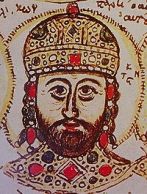
I couldn’t help but think, as I read the article, that as these Renaissance pioneers were rediscovering an ancient world in the West that had been lo200px-Constantine_XI_Palaiologos_miniaturest for so many centuries, in Constantinople at that same
approximate time the very last Caesar, the Emperor Constantine XI (see contemporary image at right) was battling Mehmed the Conqueror to prevent the fall of Constantinople that would finally and forever extinguish what remained of the Roman Empire.  I am fascinated by this contrast, artists in the West re-learning, rediscovering their patrimony and in the East, a flickering light finally extinguished.  Incidentally, the Fall of the East that ensued when Mehmed breached the Theodosian Walls of Constantinople made the Renaissance possible, flooding Italy with scholars, artists and philosophers and the contents of the world’s greatest libraries from Constantinople that had kept the flame of ancient Greece, Rome and Persia alive while the rest of Europe had wallowed in centuries of darkness and comparative ignorance.

Here is a link to the article on the Domus Aurea in Archeology Magazine:

http://www.archaeology.org/issues/187-1509/features/3562-golden-house-of-an-emperor

And for those interested in learning a bit more about the Last Roman Emperor, Constantine XI, who will appear prominently in my next novel (now being researched), please see this fair summary in Wikipedia:

https://en.wikipedia.org/wiki/Constantine_XI_Palaiologos

The Justinian Plague and Volcanoes?

“The sun gave forth its light without brightness, and it seemed exceedingly like the sun in eclipse, for the beams it shed were not clear.” – Procopius of Caesarea

This has been an unusually rich last couple weeks for the Age of Justinian in the news but of all the recent bits, this takes the cake.

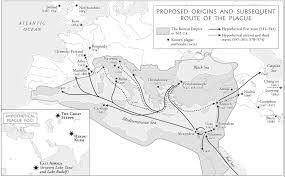
Not many know that the Black Plague of the 14th century first appeared (in recorded history) during Justinian’s reign and was one of the primary reasons for the calamities that followed (including the loss of many of Belisarius’ territorial gains and the collapse of the Persian Empire).  For more on the Justinian Plague, during which over a 1/3 of Constantinople’s one million residents died within a matter of months in the summer of 541, see the brilliant book – “Justinian’s Flea” by William Rosen (on Amazon.com).  The Justinian Plague was savage, ferocious, and more than any single factor can claim to have hastened the end of the ancient world (ushering in the Dark Ages).

This week we learned more about the origins of Justinian’s Plague.  A scientific study just published in the Journal of Nature, and summarized well for the lay-reader on Smithsonian.com, reveals that there were two epic volcanic eruptions that likely facilitated the terrifying Plague.  The first happened in 535/536 (possibly in El Salvador) and the second came later in 540 (somewhere in the Northern Hemisphere).  Together they spewed inconceivable quantities of sulfate and ash into Earth’s atmosphere and dimmed the sun around the Mediterranean Basin for years (as per the quote from Procopius above).   The dimmed sun cooled the planet, causing crops to fail and sparking widespread famine just at the very moment that y. pestis (the organism responsible for bubonic plague) began to spread northward and eastward from the Nile River Basin on the backs of rats.

The volcanic eruptions had opened the gates to Constantinople for the Plague, and Rome (and the civilized world) would never be the same.

For the article on Smithsonian.com see here:

http://www.smithsonianmag.com/science-nature/sixth-century-misery-tied-not-one-two-volcanic-eruptions-180955858/?no-ist

The Enduring Legacy of Roman Roads

Perhaps one of the most obvious and most enduring signs of Rome’s legacy lies underfoot in its network of roads that stretch from Scotland to north of the Danube, east to the Crimea and south to the Red Sea.

This article in Atlas Obscura has some fine pictures (including that of the Pont du Gard in Nimes, France pictured above) and highlights some of the more remarkable, and obscure bits of the Romans highway system that still exists across Western Europe, North Africa and the Middle East.

http://www.atlasobscura.com/articles/the-beautiful-network-of-ancient-roman-roads

Justinian Era Church Found in Israel

In another recent sign of Rome’s daunting reach in the Justinian Era, workers expanding a highway between Tel Aviv and Jerusalem recently discovered remains of an ancient Roman church from the 6th century.  Its a reminder of Justinian’s efforts to revive Rome’s presence in what was then part of the Palaestina Prima province, including a massive building campaign in Jerusalem (continuing earlier efforts begun by the Emperor Hadrian).

For more on this recent discovery see this link:

http://www.haaretz.com/life/archaeology/1.660496